

Ductile iron parts have gained significant popularity in various industries due to their excellent mechanical properties, including high strength, good ductility, and wear resistance. One crucial aspect that engineers and manufacturers often consider is the fatigue properties of ductile iron parts. As a reputable supplier of ductile iron parts, we have in - depth knowledge and extensive experience in understanding and optimizing these fatigue characteristics.
Understanding Fatigue in Ductile Iron Parts
Fatigue is the progressive and localized structural damage that occurs when a material is subjected to cyclic loading. In the context of ductile iron parts, cyclic loads can come from various sources such as vibrations in machinery, repeated impacts, or alternating stresses in rotating components. When a ductile iron part is under cyclic stress, small cracks start to initiate at points of high stress concentration. Over time, these cracks propagate, and eventually, the part fails.
The fatigue life of ductile iron parts is influenced by several factors:
- Microstructure: The microstructure of ductile iron plays a vital role in determining its fatigue properties. A well - graphite - spheroidized structure can enhance fatigue resistance. The graphite nodules in ductile iron act as stress buffers, reducing the stress concentration at crack tips. In contrast, irregularly shaped graphite or excessive carbide formation can decrease fatigue life.
- Chemical Composition: The chemical composition of ductile iron affects its mechanical and fatigue properties. Elements such as carbon, silicon, manganese, and nickel have different impacts. For example, an appropriate amount of nickel can improve the hardness and toughness of ductile iron, thereby increasing its fatigue resistance.
- Surface Finish: A smooth surface finish can reduce stress concentration and delay the initiation of fatigue cracks. Rough surfaces, on the other hand, have microscopic irregularities that act as stress - raisers, accelerating crack formation.
Factors Affecting Fatigue Strength of Ductile Iron Parts
Stress Concentration
Stress concentration occurs at geometric discontinuities such as holes, notches, and sharp corners in ductile iron parts. When a cyclic load is applied, the stress at these points can be significantly higher than the average stress in the part. For instance, in a Ductile Iron Parts Rotating Stage, the presence of mounting holes or keyways can create stress concentration areas. To mitigate this, designers often use fillets and rounded edges to reduce the stress concentration factor.
Loading Conditions
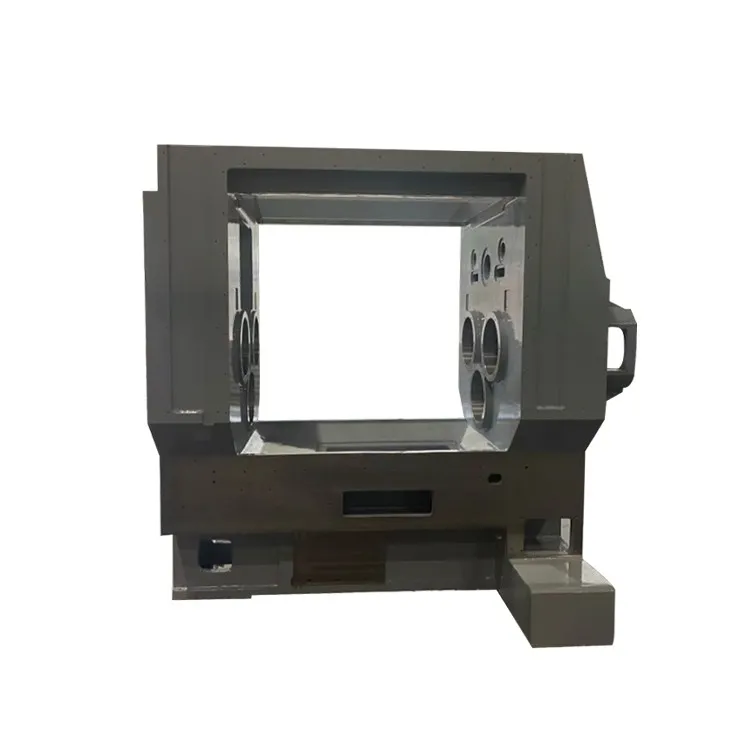
The type of cyclic loading, such as tension - compression, bending, or torsion, has a profound impact on the fatigue properties of ductile iron parts. Different loading modes induce different stress distributions within the part. For example, in a Cutting Chamber Body, the part may be subjected to both bending and impact loads during operation. The frequency and amplitude of the cyclic load also matter. High - frequency loading can lead to faster crack propagation, while large load amplitudes increase the likelihood of crack initiation.
Environmental Factors
The environment in which ductile iron parts operate can affect their fatigue life. Corrosive environments, such as those with high humidity or the presence of chemicals, can cause surface corrosion. Corrosion pits act as stress concentration sites, accelerating fatigue crack initiation. Additionally, elevated temperatures can reduce the strength and ductility of ductile iron, making the part more susceptible to fatigue failure.
Testing and Evaluation of Fatigue Properties
To accurately assess the fatigue properties of ductile iron parts, various testing methods are employed.
- Rotating Bending Fatigue Test: This test involves subjecting a specimen to cyclic bending stress by rotating it while applying a constant load. The number of cycles until failure is recorded, and the S - N curve (stress - number of cycles curve) is plotted. This curve shows the relationship between the applied stress and the fatigue life of the material.
- Tension - Compression Fatigue Test: In this test, a specimen is subjected to alternating tensile and compressive stresses. It is useful for simulating the real - world loading conditions of parts that experience this type of cyclic stress, such as engine components.
- Torsional Fatigue Test: This test applies cyclic torsional stress to a specimen. It is relevant for parts that transmit torque, like shafts and gears. For example, a Ductile Iron Casting Gearbox relies on gears that are subjected to torsional loads.
Improving Fatigue Properties of Ductile Iron Parts
As a ductile iron parts supplier, we take several measures to improve the fatigue properties of our products:
- Optimized Manufacturing Processes: We use advanced casting techniques to ensure a uniform and high - quality microstructure. Proper heat treatment processes are also applied to enhance the mechanical properties of ductile iron. For example, normalizing or quenching and tempering can improve the hardness and toughness of the parts, which in turn increases their fatigue resistance.
- Design Optimization: We work closely with our customers' design teams to optimize the part design. By reducing stress concentration points through appropriate filleting and avoiding sharp corners, we can significantly improve the part's fatigue life.
- Surface Treatment: We offer surface treatment options such as shot peening and nitriding. Shot peening creates a compressive residual stress layer on the surface of the part, which helps to resist crack initiation. Nitriding improves the surface hardness and wear resistance, enhancing the overall fatigue performance of the part.
Importance of Fatigue Properties in Different Industries
The fatigue properties of ductile iron parts are of utmost importance in various industries.
- Automotive Industry: In automotive applications, ductile iron parts such as engine blocks, crankshafts, and suspension components are subjected to cyclic loads during operation. A high fatigue life is essential to ensure the reliability and safety of vehicles.
- Aerospace Industry: In aerospace, where weight and performance are critical, ductile iron parts are used in some non - primary structural components. Their fatigue properties need to be carefully considered to meet the stringent requirements of the industry.
- Industrial Machinery: For industrial machinery, such as pumps, compressors, and conveyors, ductile iron parts need to withstand long - term cyclic loading. Good fatigue properties ensure the continuous operation of the machinery and reduce maintenance costs.
Conclusion
The fatigue properties of ductile iron parts are a complex but crucial aspect of their performance. As a ductile iron parts supplier, we understand the significance of these properties and are committed to providing high - quality products with excellent fatigue resistance. Our in - depth knowledge of the factors affecting fatigue, advanced testing methods, and effective improvement strategies allow us to meet the diverse needs of our customers across different industries.
If you are in need of high - quality ductile iron parts with outstanding fatigue properties, we invite you to contact us for a detailed discussion. Our team of experts is ready to work with you to provide the best solutions for your specific applications.

References
- Metals Handbook Committee, "Metals Handbook: Properties and Selection: Irons, Steels, and High - Performance Alloys", 10th Edition.
- ASM International, "Fatigue and Fracture", Volume 19 of the ASM Handbook.
- R. W. Hertzberg, "Deformation and Fracture Mechanics of Engineering Materials", 4th Edition.


