

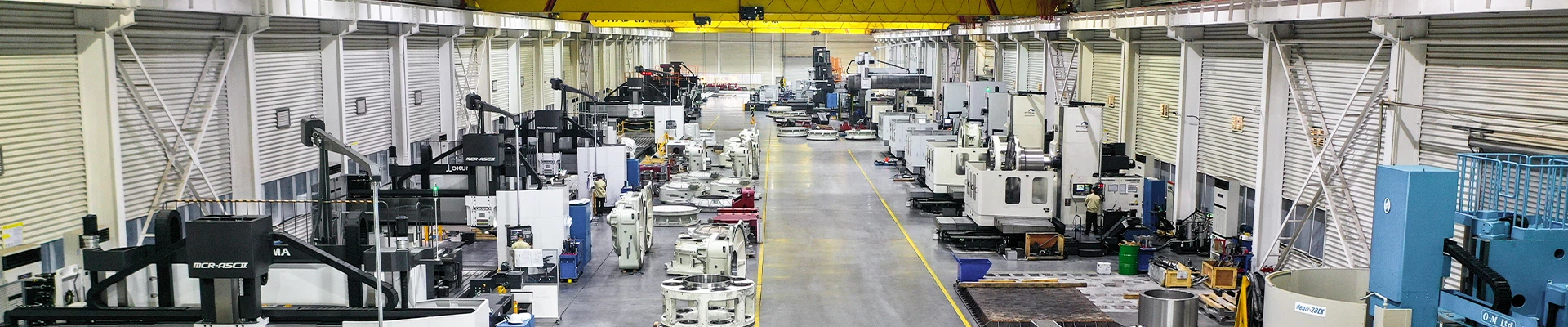


Non-ferrous Metal Parts Machining
The company has long carried out R&D cooperation and technical exchanges on mechanical processing-related topics with major colleges and universities, providing a strong technical capacity reserve and human resources guarantee for the development of the company.It provides one-stop technical services such as welding, precision machining, and surface spraying for medium and large parts, high-precision parts, and functional structural components of medium and high-end equipment.The supporting testing equipment includes three-coordinate, altimeter, hardness tester, coating thickness gauge, etc.
Why Choose Us
Professional Talent
The company attaches great importance to the improvement of technical capabilities and the introduction and training of talents. At present, there are more than 500 employees, and more than 90% of them have college degrees or above.
Production Capacity
We are committed to precision machining,with experienced process planning and mastery of programming and manufacturing standards for precision components. We can provide customers with comprehensive technical support services and solutions. We have a stable long-term cooperative relationship with suppliers.
Our Service
Demark adheres to the business philosophy of quality, innovation and service, strict manufacturing process, reliable performance quality, and mature manufacturing process technology.
My Factory
Demark (Zhejiang) Precision Technology Co., Ltd. is a high-tech enterprise that provides customers with professional high-precision machining services.


Types of Non-Ferrous Metal Parts CNC Machining Service
The Non-Ferrous Metal Parts produced by our company mainly include the following types:
Support Plate
The support plate is designed to support and fix mechanical equipment to ensure the stability and safety of the equipment. Made of high-strength materials, it has excellent load-bearing capacity and durability.
Adapter Base Plate
The adapter base plate is designed to fix and support the adapter, ensuring the adapter's stability and performance. Made of high-strength material, it has excellent load-bearing capacity and durability.
Crystal Puller
The crystal puller, also known as the crystal pulling frame, is a key device that supports and assists in the crystal growth process. It is primarily used for growing single crystals using the Czochralski method.
Characteristics and options of crystal pulling machine
|
Effective dimensions |
Crystal size up to 6” |
|
Features |
Graphite heater or induction |
|
Options |
Possibility to operate under high pressure |
|
Integration |
Possibility of Automation and software controled growth process |
A crystal puller is used to create silicon ingots for use in the semiconductor industry. A large quantity of pure crushed polycrystalline silicon is combined with additional elements and then melted in the puller's large crucible, which is surrounded by an inert gas atmosphere, usually argon gas. Once the mixture is combined, it is cooled, and then a single crystal of silicon is added. This crystal serves as a "seed," which is then drawn or "pulled" up while being rotated. A small amount of the mixture rises with the "seed," pulled upward by surface tension, and cools into a single large rod called an ingot. The length and diameter of the ingot is determined by the pulling speed and the ambient temperature. The ingot is then cut into wafers and polished, creating the base material on which semiconductors are constructed.

Specifications of Adapter Base Plate
|
Model |
15MP |
|
Type |
Adapter Base Plate |
|
Dimensional Tolerance |
Axis hole concentricity 0.03 Flatness 0.02 Parallelism 0.03 Verticality 0.01 |
|
Material |
Aluminum alloy/stainless steel/6061-T6 |
|
Weight |
0.279kg |
|
Processing Time |
35H |
Specifications of Support Plate
|
Use Scenarios |
Mechanical equipment, electronic equipment |
|
Type |
Stage Adapter |
|
Processing Time |
40H |
|
Material |
High strength steel/aluminum alloy/6061-T6 |
|
Weight |
10-50kg |
|
Processing Technology |
1. Rough machining 2. Vibration aging 3. Semi-finishing 4. Finishing 5. Surface treatment |
Application Of Support Plate
Mechanical Engineering and Construction
A support plate is generally used to describe a structural element intended to support loads and offer stability in this field.
Manufacturing and Machining
A support plate may be utilised in these processes to keep tools or workpieces stable while they are being operated on For instance, in applications involving drilling or milling, a support plate can offer a steady surface for the workpiece, guaranteeing accuracy and precision during the machining process.
Heat Exchangers and HVAC Systems
A support plate may be a part of an HVAC (Heating, Ventilation, and Air Conditioning) system that is used to accommodate or fasten heat exchanger tubes.
Electronics and printed circuit boards (PCBs)
When designing PCBs and electronics, a rigid structure called a support plate may be utilised to mount and support electronic components.
Automotive Sector
Support plates find application in a range of automotive components, including suspension systems, engine mounts, and brake assemblies.
Biomechanics and Medical Devices
A support plate can be a part of an orthopaedic device, prosthetic, or implant in biomechanics and medical device design.
Scientific Research and Instrumentation
In scientific research, support plates are also frequently used, especially when building specialised tools and apparatus.
Support plates are flat or perforated plates typically made from materials that can withstand the operational conditions of the equipment.
They are strategically placed at specific locations within a column or vessel to provide support to the weight of the internals (packing, trays, etc.) or the material being processed.
In columns, support plates can be located above or between packed beds, trays, or other internals to prevent deformation and ensure uniform distribution of the load.
Support plates can also serve as distributor plates, aiding in the even distribution of fluids (liquid or gas) across a specific cross-sectional area.
Company Certificate


