

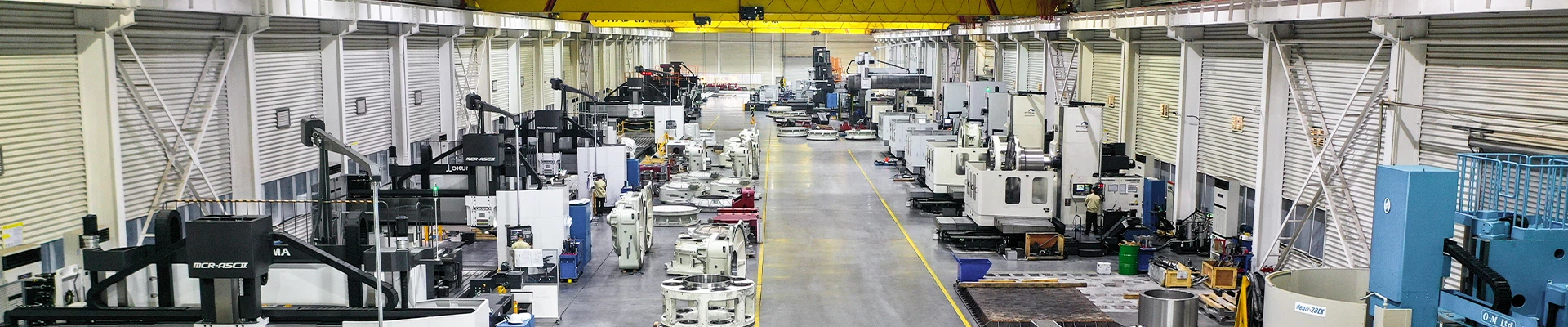


Welded Structural Parts Machining
The company has long carried out R&D cooperation and technical exchanges on mechanical processing-related topics with major colleges and universities, providing a strong technical capacity reserve and human resources guarantee for the development of the company.It provides one-stop technical services such as welding, precision machining, and surface spraying for medium and large parts, high-precision parts, and functional structural components of medium and high-end equipment.The supporting testing equipment includes three-coordinate, altimeter, hardness tester, coating thickness gauge, etc.
Why Choose Us
Professional Talent
The company attaches great importance to the improvement of technical capabilities and the introduction and training of talents. At present, there are more than 500 employees, and more than 90% of them have college degrees or above.
Production Capacity
We are committed to precision machining,with experienced process planning and mastery of programming and manufacturing standards for precision components. We can provide customers with comprehensive technical support services and solutions. We have a stable long-term cooperative relationship with suppliers.
Our Service
Demark adheres to the business philosophy of quality, innovation and service, strict manufacturing process, reliable performance quality, and mature manufacturing process technology.
My Factory
Demark (Zhejiang) Precision Technology Co., Ltd. is a high-tech enterprise that provides customers with professional high-precision machining services.


There are many types of welded structural parts, and the production processes and requirements are also different. The corresponding welding fixtures and displacement machines are also very different in form, working principle and technical requirements. With the expansion of the application range of welded structural parts and the improvement of the level of mechanization and automation of welding production, the types of auxiliary mechanical equipment such as fixtures and displacement machines used in the production of welded structural parts will also continue to increase. According to the use of these auxiliary mechanical equipment or welding process equipment, it can be divided into four categories: Welding fixture, welding displacement machinery, welding process combination machinery, and welding auxiliary equipment. The jig used for assembling and positioning the workpiece is called a jig; The jig used for welding the workpiece is called a welding jig, and the jig used for assembling and welding is called an assembly welding jig. They are collectively called welding fixtures. Welding fixtures are divided into six categories according to the power source: Manual fixtures, pneumatic fixtures, hydraulic fixtures, magnetic fixtures, vacuum fixtures, and electric fixtures.
Advantages Of Welded Structural Parts
Strength
Welded joints can provide high strength, often comparable to or exceeding the strength of the base materials being joined.
Flexibility
Welding allows for the fabrication of complex shapes and structures, providing designers with flexibility in creating custom solutions to fit specific needs.
Cost-effectiveness
Welding can often be a cost-effective method of joining materials compared to alternatives like mechanical fastening or adhesive bonding.
Efficiency
Welding processes can be highly efficient, enabling rapid production of large quantities of parts or structures.
Weight savings
Welded joints can be designed to minimize excess material, resulting in lighter weight structures compared to alternative joining methods.
Enhanced aesthetics
Welded joints can often provide a cleaner and more aesthetically pleasing appearance compared to other joining methods.
Durability
When performed correctly, welded joints can exhibit excellent durability and resistance to fatigue, corrosion, and other forms of degradation.
Seamlessness
Welded joints can create seamless connections between parts, reducing the likelihood of stress concentrations or weak points that can compromise the integrity of the structure.
Procedure Specifications Of Welded Structural Parts

Joint Design
The design of the joint determines how two or more pieces of metal are connected. Common joint types in structural welding include butt joints, fillet joints, lap joints, and T-joints.
Preparation and Fit-Up
Proper preparation of the joint surfaces is essential for achieving quality welds. This includes cleaning the metal surfaces, ensuring proper fit-up of the pieces to be welded, and maintaining the correct gap and alignment between them.
Welding Positions
Structural welding may involve welding in various positions, including flat, horizontal, vertical, and overhead. Welders need to be skilled in welding in different positions to meet the demands of the specific structural components.
Quality Control and Inspection
Structural welding requires stringent quality control measures. Inspections are conducted during and after welding to ensure compliance with specified standards and codes.
Safety
Safety is paramount in structural welding. Welders must use personal protective equipment (PPE), follow safety protocols, and be aware of potential hazards associated with welding, such as fumes, arc radiation, and electrical hazards.
Main Materials Of Welded Structural Parts
The parts of welded structural parts are mostly made of metal rolling materials (sheets and profiles) as blanks, and a small amount of castings, forgings and stampings are used as blanks. Most of the latter can be directly welded, except for some processes that require machining, cutting (blanking), edge processing, forming and bending, and bevel cleaning before welding.
The workload of metal material processing occupies a considerable proportion in welding production. For example, in heavy machinery welding structural parts, it accounts for about 25% to 60% of all processing hours. Therefore, improving the mechanization level of material processing technology and adopting advanced processing methods play an important role in improving processing quality and labor productivity.
Application of Welded Structural Parts
Manufacturing and Aerospace
Manufacturing and aerospace industries rely on structural welding to create everything from industrial machinery to aircraft. Welders in these fields work with various metals, including aluminum and titanium, and must meet rigorous safety standards.
Oil, Gas, and Energy Sectors
Structural welders are essential in the oil and gas industry for the construction and maintenance of pipelines, drilling rigs, and related infrastructure.
Automotive and Transportation
In the automotive and transportation sectors, structural welders contribute to the fabrication of parts and assemblies that make up vehicles, trains, and other modes of transportation.
Company Certificate


