

In the realm of industrial manufacturing, cast carbon steel parts play a pivotal role, finding applications across a wide range of sectors, from power generation to automotive and heavy machinery. As a seasoned supplier of cast carbon steel parts, I've witnessed firsthand the unique challenges that come with manufacturing complex - shaped components. These challenges not only require technical expertise but also a deep understanding of metallurgy, engineering, and production processes.
Material Selection and Composition
One of the primary challenges in manufacturing complex - shaped cast carbon steel parts lies in material selection and composition. Carbon steel is an alloy of iron and carbon, with varying amounts of other elements such as manganese, silicon, sulfur, and phosphorus. The exact composition of the steel significantly impacts its mechanical properties, including strength, hardness, ductility, and corrosion resistance.
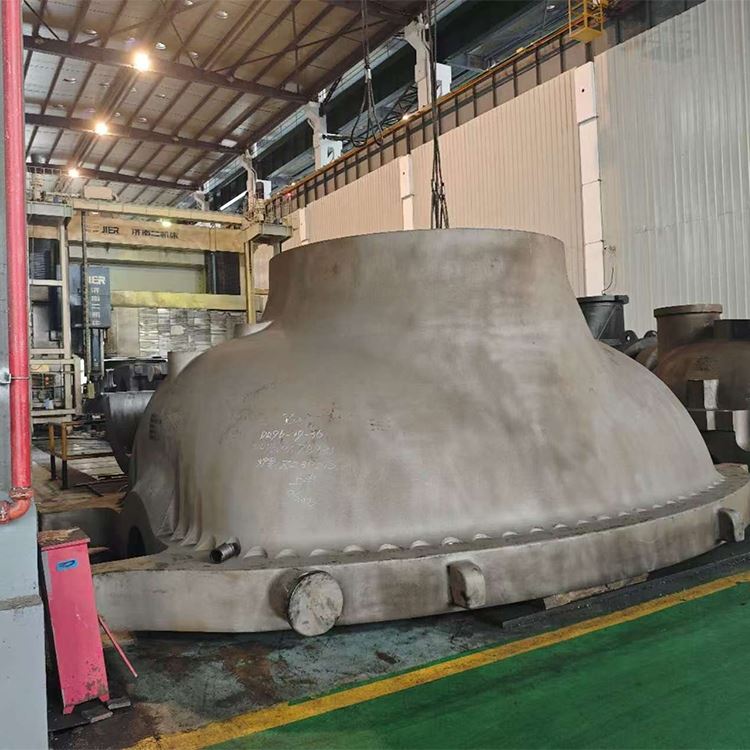
For complex - shaped parts, the material must be carefully chosen to ensure it can withstand the stresses and strains it will encounter during its service life. For instance, in applications like Large Turbine Housings, the steel needs to have high strength and good fatigue resistance to endure the high - speed rotation and pressure changes within the turbine. At the same time, it should also have excellent machinability to allow for precise finishing of the complex internal and external features.
Achieving the right balance of elements in the steel composition is a delicate process. Minor variations in the content of alloying elements can lead to significant differences in the final properties of the cast part. For example, an excessive amount of sulfur can reduce the weldability and ductility of the steel, while an insufficient amount of manganese may result in poor hardenability. Therefore, strict quality control measures must be in place during the melting and refining processes to ensure the consistency of the steel composition.
Design and Pattern Making
The design of complex - shaped cast carbon steel parts presents another set of challenges. These parts often have intricate geometries, thin walls, undercuts, and internal cavities, which make them difficult to manufacture using traditional casting methods. The design must take into account not only the functional requirements of the part but also the limitations of the casting process.
Pattern making is a crucial step in the casting process, as it determines the shape and dimensions of the final cast part. For complex - shaped parts, creating an accurate pattern can be extremely challenging. Patterns need to be made with high precision to ensure that the castings meet the required tolerances. In some cases, advanced techniques such as 3D printing may be used to create patterns, especially for parts with very complex geometries. However, 3D - printed patterns also have their limitations, such as limited material options and potential issues with surface finish.
Another aspect of design and pattern making is the consideration of shrinkage. During the solidification process, carbon steel undergoes shrinkage, which can cause dimensional changes in the cast part. For complex - shaped parts, predicting and compensating for shrinkage accurately is a complex task. If the shrinkage is not properly accounted for in the pattern design, the final cast part may not meet the specified dimensions, leading to costly rework or even rejection.
Casting Process
The casting process itself is fraught with challenges when it comes to complex - shaped cast carbon steel parts. One of the main issues is the filling of the mold cavity. Complex geometries can create obstacles to the smooth flow of molten steel, leading to incomplete filling, cold shuts, and other casting defects.
In order to ensure proper filling, factors such as the gating system design, pouring temperature, and pouring speed need to be carefully optimized. The gating system is responsible for directing the molten steel into the mold cavity, and its design must be tailored to the specific shape of the part. For example, for parts with thin walls, a well - designed gating system is essential to ensure that the molten steel can reach all areas of the mold before it solidifies.
The pouring temperature also plays a critical role. If the temperature is too low, the molten steel may solidify before filling the entire mold cavity, resulting in incomplete castings. On the other hand, if the temperature is too high, it can lead to increased oxidation, porosity, and other defects. Similarly, the pouring speed needs to be carefully controlled to avoid turbulence and air entrapment in the molten steel.
Another challenge in the casting process is the control of solidification. Complex - shaped parts often have uneven wall thicknesses, which can cause differential cooling rates during solidification. This can lead to the formation of internal stresses, warping, and cracking in the cast part. To minimize these issues, techniques such as riser design and insulation may be used to control the cooling rate and ensure uniform solidification.
Heat Treatment
Heat treatment is an important step in the manufacturing of cast carbon steel parts, as it can significantly improve their mechanical properties. However, for complex - shaped parts, heat treatment can be particularly challenging.
During heat treatment, the part is subjected to high temperatures and then cooled at a controlled rate. The uneven geometry of complex - shaped parts can cause non - uniform heating and cooling, leading to variations in the microstructure and mechanical properties across the part. For example, in parts with thick and thin sections, the thick sections may cool more slowly than the thin sections, resulting in different levels of hardness and strength.
To address these issues, specialized heat treatment processes may need to be developed. This may involve the use of custom - designed fixtures to ensure uniform heating and cooling, as well as careful monitoring of the temperature distribution within the part. In addition, post - heat treatment machining may be required to remove any distortion or dimensional changes that occur during the heat treatment process.
Machining and Finishing
After casting and heat treatment, complex - shaped cast carbon steel parts often require extensive machining and finishing operations to achieve the desired final dimensions and surface quality. Machining complex geometries can be difficult due to the presence of tight tolerances, internal cavities, and irregular surfaces.
The choice of machining tools and techniques is crucial for achieving high - quality results. For example, for parts with complex internal features, specialized tools such as end mills and drills may be required. In addition, the machining process must be carefully planned to minimize the risk of tool breakage and to ensure that the part is not damaged during machining.
Finishing operations, such as grinding, polishing, and coating, are also important for improving the surface quality and corrosion resistance of the cast parts. However, for complex - shaped parts, achieving a uniform finish can be challenging. The uneven surfaces and intricate geometries can make it difficult to apply coatings evenly, and the use of abrasive finishing techniques may be limited by the risk of damaging the part.
Quality Control
Quality control is of utmost importance in the manufacturing of complex - shaped cast carbon steel parts. These parts are often used in critical applications, where any defect can have serious consequences. Therefore, a comprehensive quality control system must be in place throughout the manufacturing process.
Non - destructive testing methods, such as ultrasonic testing, radiographic testing, and magnetic particle testing, are commonly used to detect internal defects in the cast parts. These tests can help identify issues such as porosity, cracks, and inclusions before the part is put into service. In addition, dimensional inspection using coordinate measuring machines (CMMs) is essential to ensure that the part meets the specified tolerances.
However, quality control for complex - shaped parts can be more challenging than for simple - shaped parts. The intricate geometries can make it difficult to access all areas of the part for testing, and the interpretation of test results may be more complex. Therefore, trained personnel and advanced testing equipment are required to ensure accurate and reliable quality control.
Conclusion
Manufacturing complex - shaped cast carbon steel parts is a challenging but rewarding endeavor. As a supplier, we constantly strive to overcome these challenges through continuous innovation, technical expertise, and strict quality control. By understanding the unique requirements of each part and applying the appropriate manufacturing processes, we can produce high - quality cast carbon steel parts that meet the needs of our customers.
If you are in the market for high - quality cast carbon steel parts, whether it's Large Turbine Housings, Connecting Flange, or Cylinder Support, we invite you to reach out to us for a procurement discussion. Our team of experts is ready to work with you to meet your specific requirements and provide you with the best solutions.

References
- Campbell, J. (2003). Castings. Butterworth - Heinemann.
-ASM Handbook Committee. (1990). ASM Handbook, Volume 15: Casting. ASM International. - DeGarmo, E. P., Black, J. T., & Kohser, R. A. (2003). Materials and Processes in Manufacturing. John Wiley & Sons.


