

Hey there! I'm working for a large turbine housings supplier, and today I wanna chat about the aerodynamic principles applied in large turbine housing design.
First off, let's understand why aerodynamics is such a big deal in turbine housing design. Turbines are all about converting the energy of a fluid (usually air or gas) into mechanical energy. The efficiency of this conversion depends a lot on how well the fluid flows through the turbine housing. If the flow is smooth and efficient, more energy can be extracted from the fluid, which means better performance and less wasted energy.
One of the key aerodynamic principles at play is the concept of streamlining. You know how a fish or a plane is shaped to move through its medium with as little resistance as possible? Well, the same idea applies to turbine housings. A streamlined housing reduces drag, which is the force that opposes the motion of the fluid. When drag is minimized, the fluid can flow more freely through the turbine, allowing it to spin more efficiently.
To achieve streamlining, turbine housing designers often use curved surfaces. These curved surfaces help to guide the fluid smoothly around the housing, preventing the formation of turbulent eddies. Turbulence is bad news because it disrupts the flow of the fluid and can cause energy losses. By using curved surfaces, designers can keep the flow laminar, or smooth, for as long as possible.
Another important principle is the control of pressure gradients. Pressure gradients are differences in pressure between different points in the fluid. In a turbine housing, designers need to carefully manage these pressure gradients to ensure that the fluid flows in the right direction and at the right speed. For example, they might design the housing so that the pressure is higher at the inlet and lower at the outlet. This pressure difference creates a driving force that pushes the fluid through the turbine.

To control pressure gradients, designers use a variety of techniques. One common technique is to vary the cross-sectional area of the housing. By narrowing or widening the housing at different points, designers can change the speed and pressure of the fluid. For example, narrowing the housing at the inlet can increase the speed of the fluid, while widening it at the outlet can decrease the speed and increase the pressure.
In addition to streamlining and pressure gradient control, turbine housing designers also need to consider the effects of boundary layers. The boundary layer is a thin layer of fluid that forms along the surface of the housing. This layer can have a significant impact on the flow of the fluid and the performance of the turbine.
If the boundary layer is too thick, it can cause separation, which is when the fluid stops flowing smoothly along the surface of the housing and instead forms turbulent eddies. Separation can lead to increased drag and reduced efficiency. To prevent separation, designers often use techniques such as surface roughness control and boundary layer suction.
Surface roughness control involves making the surface of the housing as smooth as possible. A smooth surface reduces the friction between the fluid and the housing, which helps to keep the boundary layer thin. Boundary layer suction, on the other hand, involves removing the slow-moving fluid from the boundary layer using small holes or slots in the housing. This helps to keep the boundary layer attached to the surface of the housing and prevents separation.
Now, let's talk about some of the specific components of a large turbine housing and how aerodynamic principles are applied to them.
One important component is the inlet. The inlet is where the fluid enters the turbine housing, and it plays a crucial role in determining the performance of the turbine. To ensure that the fluid enters the housing smoothly and efficiently, designers often use a bell-shaped inlet. This shape helps to guide the fluid towards the center of the housing and reduces the formation of turbulent eddies.
Another important component is the volute. The volute is a spiral-shaped chamber that surrounds the turbine blades. Its main function is to collect the fluid as it exits the turbine blades and to convert the kinetic energy of the fluid into pressure energy. To achieve this, the volute is designed to gradually increase in cross-sectional area as the fluid moves around the spiral. This causes the fluid to slow down and the pressure to increase.
The turbine blades themselves are also designed with aerodynamics in mind. The shape of the blades is carefully optimized to maximize the amount of energy that can be extracted from the fluid. The blades are typically curved and have a specific angle of attack, which is the angle between the blade and the direction of the fluid flow. By adjusting the angle of attack, designers can control the amount of lift and drag generated by the blades.
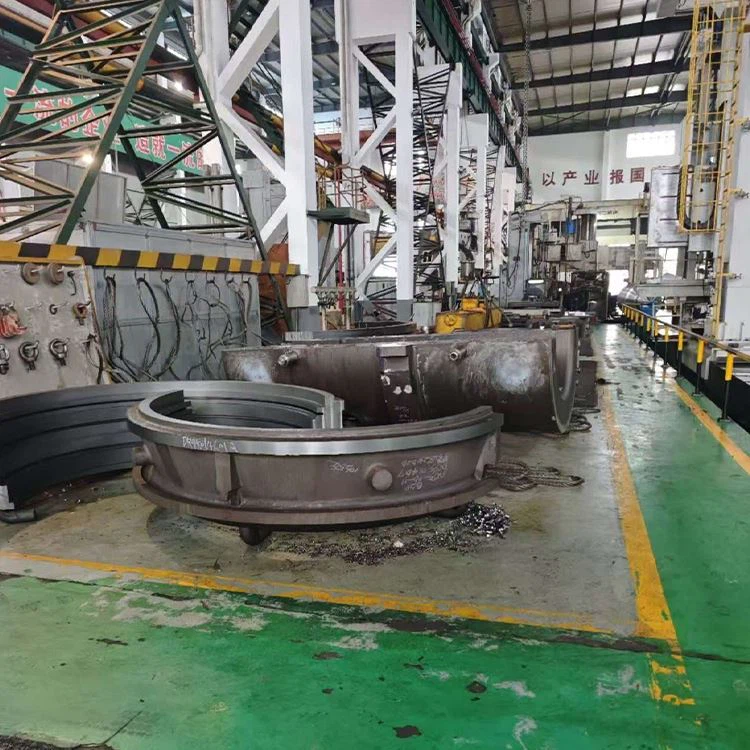
In addition to these components, large turbine housings may also include other features such as Hexahedral Cavity, Cylinder Support, and Large Steel Casting Shell Cast Steel Joint. These features are designed to provide structural support and to ensure that the housing can withstand the high pressures and temperatures generated by the turbine.
So, there you have it! These are some of the key aerodynamic principles applied in large turbine housing design. By understanding and applying these principles, designers can create turbine housings that are more efficient, reliable, and durable.
If you're in the market for large turbine housings, we'd love to hear from you. Our team of experts has years of experience in designing and manufacturing high-quality turbine housings that are optimized for aerodynamic performance. Whether you need a custom-designed housing or a standard off-the-shelf model, we can provide you with the solution that meets your needs. So, don't hesitate to get in touch and start a conversation about your turbine housing requirements.
References
- Anderson, J. D. (2001). Fundamentals of Aerodynamics. McGraw-Hill.
- Pope, A., & Goin, K. L. (1965). High-Speed Aerodynamics. John Wiley & Sons.
- White, F. M. (2003). Fluid Mechanics. McGraw-Hill.


