

Aging is a natural and inevitable process that affects a wide range of materials, including cast carbon steel parts. As a supplier of high - quality cast carbon steel parts, I have witnessed firsthand how aging can bring about significant changes in the properties of these components. In this blog, I will delve into the various ways in which aging impacts the properties of cast carbon steel parts, exploring both the physical and mechanical aspects.
Microstructural Changes
One of the most fundamental ways aging affects cast carbon steel parts is through microstructural changes. Over time, the internal structure of the steel undergoes alterations that can have a profound impact on its properties. At the atomic level, diffusion processes occur within the steel matrix. Carbon atoms, which are initially in a metastable state after casting, gradually migrate and form carbide precipitates.
These carbide precipitates can strengthen the steel through a mechanism known as precipitation hardening. As the aging process continues, the size and distribution of these carbides change. In the early stages of aging, fine carbide particles are formed, which act as obstacles to dislocation movement. Dislocations are line defects in the crystal structure of the steel, and their movement is responsible for plastic deformation. By impeding dislocation movement, the fine carbide particles increase the strength and hardness of the cast carbon steel.
However, as aging progresses further, the carbide particles may coarsen. Coarse carbides are less effective at blocking dislocation movement compared to fine carbides. This can lead to a decrease in strength and an increase in brittleness. The change in the size and distribution of carbides also affects the ductility of the steel. Ductility is the ability of a material to deform plastically before fracturing. With the coarsening of carbides, the ductility of the cast carbon steel part may be reduced, making it more prone to cracking under stress.
Mechanical Property Variations
Strength and Hardness
As mentioned earlier, aging can initially increase the strength and hardness of cast carbon steel parts. This can be beneficial in applications where high strength is required, such as in Large Steel Casting Shell Cast Steel Joint. These joints need to withstand high loads and stresses during operation. The precipitation hardening effect during the early stages of aging can enhance their load - bearing capacity.
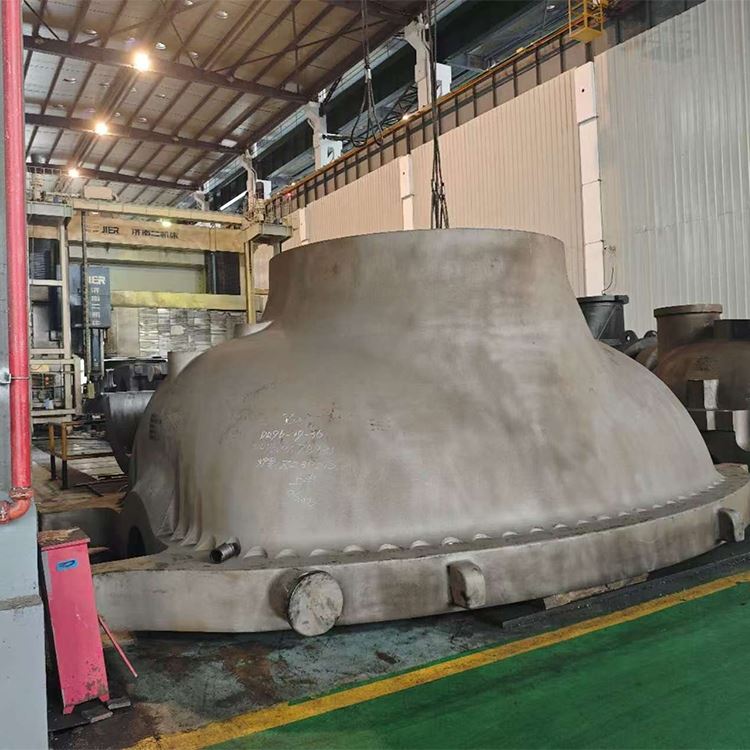

However, over - aging can cause a decline in strength. This is a critical factor to consider, especially in safety - critical applications. For example, in Large Turbine Housings, a decrease in strength due to over - aging can compromise the integrity of the housing and lead to potential failures. The hardness of the steel also follows a similar trend. Initially, hardness increases with aging, but it may decrease if the steel is aged for too long.
Fatigue Resistance
Fatigue is a major concern in many applications of cast carbon steel parts. Fatigue failure occurs when a material is subjected to repeated cyclic loading. Aging can have a complex effect on the fatigue resistance of cast carbon steel. In the early stages of aging, the increased strength and hardness can improve the fatigue limit of the steel. The fine carbide particles can prevent the initiation and propagation of fatigue cracks.
However, as the steel ages further and becomes more brittle, its fatigue resistance may be negatively affected. Brittleness reduces the ability of the material to absorb energy during cyclic loading. Cracks are more likely to initiate and propagate in a brittle material, leading to premature fatigue failure. This is particularly important in components like Large Steel Casting Box, which may be subjected to cyclic vibrations and loads during normal operation.
Corrosion Resistance
Aging can also influence the corrosion resistance of cast carbon steel parts. The microstructural changes that occur during aging can affect the surface properties of the steel. For example, the formation of carbide precipitates can create local differences in the electrochemical potential of the steel. This can lead to the formation of galvanic cells on the surface of the steel, where the carbides act as anodes and the surrounding matrix acts as a cathode.
In an aqueous environment, the anodic regions (carbides) are more likely to corrode. As a result, the corrosion rate of the cast carbon steel part may increase with aging. Additionally, the brittleness caused by over - aging can make the steel more susceptible to stress - corrosion cracking. Stress - corrosion cracking is a form of corrosion that occurs when a material is under tensile stress in a corrosive environment. The combination of stress and corrosion can lead to the sudden and catastrophic failure of the cast carbon steel part.
Impact on Dimensional Stability
Another aspect affected by aging is the dimensional stability of cast carbon steel parts. The microstructural changes during aging can cause internal stresses to develop within the steel. These internal stresses can lead to dimensional changes over time. For example, if a cast carbon steel part is initially machined to precise dimensions, the internal stresses generated during aging may cause it to warp or distort.
This is a significant issue in applications where tight tolerances are required. In precision machinery or equipment, even small dimensional changes can affect the performance and functionality of the components. As a supplier of cast carbon steel parts, we need to take these potential dimensional changes into account during the manufacturing and quality control processes.
Mitigating the Effects of Aging
To minimize the negative effects of aging on cast carbon steel parts, several strategies can be employed. One approach is to control the aging process carefully. By optimizing the aging time and temperature, we can ensure that the steel reaches an optimal balance between strength, hardness, and ductility. Heat treatment processes can also be used to reverse some of the negative effects of over - aging. For example, a re - normalization heat treatment can be applied to refine the microstructure and improve the mechanical properties of the steel.
Surface treatments can also enhance the corrosion resistance of cast carbon steel parts. Coating the parts with protective layers, such as paints or metallic coatings, can prevent direct contact between the steel and the corrosive environment. This can significantly reduce the risk of corrosion and stress - corrosion cracking.
Conclusion
In conclusion, aging has a profound impact on the properties of cast carbon steel parts. It affects the microstructure, mechanical properties, corrosion resistance, and dimensional stability of these components. As a supplier of cast carbon steel parts, understanding these effects is crucial for ensuring the quality and performance of our products.
We offer a wide range of high - quality cast carbon steel parts, including Large Steel Casting Shell Cast Steel Joint, Large Turbine Housings, and Large Steel Casting Box. If you are in need of reliable cast carbon steel parts, we invite you to contact us for procurement and further discussions. Our team of experts is ready to assist you in finding the best solutions for your specific requirements.
References
- ASM Handbook, Volume 1: Properties and Selection: Irons, Steels, and High - Performance Alloys. ASM International.
- Dieter, G. E. (1986). Mechanical Metallurgy. McGraw - Hill.
- Callister, W. D., & Rethwisch, D. G. (2011). Materials Science and Engineering: An Introduction. Wiley.


