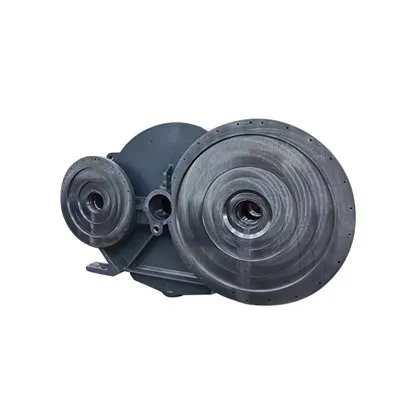
Ductile iron parts are widely used in various industries due to their excellent mechanical properties, such as high strength, good ductility, and wear resistance. However, one of the significant challenges faced by these parts is corrosion, which can significantly affect their performance and service life. As a ductile iron parts supplier, understanding the factors influencing the corrosion rate of ductile iron parts is crucial for providing high - quality products and solutions to our customers.
1. Chemical Composition of Ductile Iron
The chemical composition of ductile iron plays a fundamental role in determining its corrosion resistance. Ductile iron mainly consists of iron (Fe), carbon (C), silicon (Si), manganese (Mn), sulfur (S), and phosphorus (P), along with some trace elements.
Carbon is an essential element in ductile iron. Higher carbon content can lead to the formation of more graphite nodules. While graphite itself is relatively inert, it can act as a cathode in a galvanic cell, accelerating the corrosion of the iron matrix. Silicon is beneficial for improving the corrosion resistance of ductile iron. It forms a passive oxide film on the surface of the material, which can prevent the penetration of corrosive agents. Manganese can combine with sulfur to form manganese sulfide (MnS) inclusions. These inclusions can act as initiation sites for corrosion, especially in environments containing chloride ions. Sulfur and phosphorus are generally considered impurities in ductile iron. High sulfur content can increase the brittleness of the material and promote corrosion, while high phosphorus content can lead to the formation of a brittle phase at the grain boundaries, reducing the corrosion resistance of the material.
2. Microstructure of Ductile Iron
The microstructure of ductile iron also has a significant impact on its corrosion rate. The main microstructural components of ductile iron are graphite nodules and the iron matrix. The size, shape, and distribution of graphite nodules can affect the corrosion behavior of the material.
Smaller and more uniformly distributed graphite nodules are beneficial for improving the corrosion resistance of ductile iron. When the graphite nodules are small and evenly distributed, the anodic - cathodic area ratio is more favorable, reducing the galvanic corrosion effect. The type of iron matrix, such as ferrite, pearlite, or a mixture of both, also affects the corrosion rate. Ferrite has relatively good corrosion resistance in some environments, while pearlite is more prone to corrosion due to the presence of cementite. In addition, the presence of other phases or inclusions in the microstructure, such as carbides or phosphides, can also act as initiation sites for corrosion, accelerating the corrosion process.
3. Environmental Factors
3.1 Temperature
Temperature is an important environmental factor that affects the corrosion rate of ductile iron parts. Generally, an increase in temperature can accelerate the corrosion reaction. As the temperature rises, the kinetic energy of the atoms and ions in the system increases, which promotes the diffusion of corrosive agents and the dissolution of the metal. In addition, higher temperatures can also change the solubility of gases and salts in the corrosive medium, further affecting the corrosion process.
However, in some cases, a moderate increase in temperature can also lead to the formation of a more stable passive film on the surface of the material, which can slow down the corrosion rate. For example, in some alkaline environments, a certain temperature range can promote the formation of a protective iron oxide film on the surface of ductile iron.
3.2 pH Value of the Environment
The pH value of the environment is another crucial factor influencing the corrosion rate of ductile iron parts. In acidic environments, the hydrogen ions (H⁺) in the solution can react with the iron in the ductile iron, causing the dissolution of the metal. The reaction can be represented as follows:
Fe + 2H⁺ → Fe²⁺+ H₂↑
As the pH value decreases, the concentration of hydrogen ions increases, and the corrosion rate of ductile iron increases accordingly.
In alkaline environments, the iron in ductile iron can react with hydroxide ions (OH⁻) to form iron hydroxide (Fe(OH)₂), which can further oxidize to form iron oxide (Fe₂O₃). At a certain pH range, a stable passive film can be formed on the surface of the material, which can protect the underlying metal from further corrosion. However, if the pH value is too high, the passive film may be destroyed, leading to an increase in the corrosion rate.
3.3 Presence of Corrosive Agents
The presence of corrosive agents in the environment, such as chloride ions (Cl⁻), sulfate ions (SO₄²⁻), and oxygen (O₂), can significantly affect the corrosion rate of ductile iron parts.
Chloride ions are particularly aggressive towards ductile iron. They can penetrate the passive film on the surface of the material, causing pitting corrosion. Once pitting corrosion occurs, it can quickly progress, leading to the failure of the part. Sulfate ions can react with the iron in ductile iron to form iron sulfate (FeSO₄), which can further accelerate the corrosion process. Oxygen is an essential component in the corrosion process of ductile iron. It participates in the electrochemical reaction as an oxidizing agent, promoting the dissolution of the metal. In environments with high oxygen content, the corrosion rate of ductile iron is generally higher.
4. Surface Condition of Ductile Iron Parts
The surface condition of ductile iron parts can also affect their corrosion rate. Surface roughness, surface defects, and the presence of contaminants can all influence the corrosion behavior of the material.
A rough surface provides more sites for the adsorption of corrosive agents, increasing the contact area between the material and the corrosive medium. This can lead to a higher corrosion rate compared to a smooth surface. Surface defects, such as cracks, pores, and inclusions, can act as initiation sites for corrosion. They can disrupt the integrity of the passive film on the surface of the material, allowing corrosive agents to penetrate into the interior of the material. Contaminants on the surface of ductile iron parts, such as oil, grease, and dirt, can prevent the formation of a uniform passive film and provide a favorable environment for the growth of microorganisms, which can also accelerate the corrosion process.
5. Stress and Strain
Stress and strain can also influence the corrosion rate of ductile iron parts. When a ductile iron part is under stress, the lattice structure of the material is distorted, which can increase the energy of the atoms at the surface. This makes the material more reactive and prone to corrosion.
In addition, stress can cause the formation and propagation of cracks in the material. These cracks can act as channels for the penetration of corrosive agents, accelerating the corrosion process. Fatigue stress, which is caused by cyclic loading, can also have a significant impact on the corrosion resistance of ductile iron parts. The combination of fatigue stress and corrosion can lead to a phenomenon called corrosion - fatigue, which can significantly reduce the service life of the parts.
6. Protective Coatings and Treatments
Applying protective coatings and treatments is an effective way to reduce the corrosion rate of ductile iron parts. There are various types of coatings and treatments available, such as paint coatings, galvanizing, and passivation.


Paint coatings can provide a physical barrier between the ductile iron part and the corrosive environment. They can prevent the penetration of corrosive agents and protect the underlying metal. Galvanizing involves coating the surface of the ductile iron part with a layer of zinc. Zinc is more electro - negative than iron, so it acts as a sacrificial anode, protecting the iron from corrosion. Passivation is a chemical treatment that can form a thin, protective oxide film on the surface of the ductile iron part. This film can improve the corrosion resistance of the material by preventing the reaction between the metal and the corrosive agents.
As a ductile iron parts supplier, we offer a wide range of high - quality ductile iron products, such as Ductile Iron Parts Rotating Stage, Compressor Rotor, and Ductile Iron Casting Gearbox. We understand the importance of corrosion resistance for our products, and we take various measures to ensure the high - quality and long - service life of our ductile iron parts. If you are interested in our products or have any questions about the corrosion resistance of ductile iron parts, please feel free to contact us for procurement and negotiation.
References
- Jones, D. A. (1992). Principles and Prevention of Corrosion. Macmillan Publishing Company.
- Uhlig, H. H., & Revie, R. W. (1985). Corrosion and Corrosion Control: An Introduction to Corrosion Science and Engineering. John Wiley & Sons.
- Fontana, M. G. (1986). Corrosion Engineering. McGraw - Hill.