

As a seasoned supplier of support plates, I've witnessed firsthand the pivotal role these components play across various industries. Support plates are not just simple pieces of material; they are engineered solutions designed to provide stability, distribute loads, and ensure the proper functioning of equipment. In this blog, I'll delve into the key design considerations for support plates, drawing on my extensive experience in the field.
Material Selection
The choice of material is one of the most fundamental design considerations for support plates. Different materials offer varying properties such as strength, corrosion resistance, and thermal conductivity, which must be carefully evaluated based on the specific application requirements.
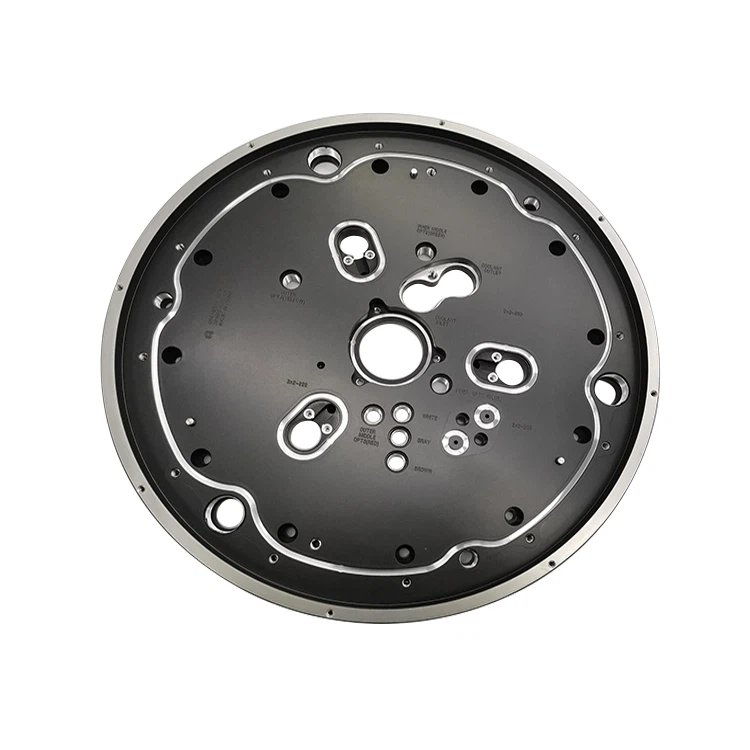
- Metals: Metals are commonly used for support plates due to their high strength and durability. Steel, for example, is a popular choice for applications requiring high load-bearing capacity. Stainless steel, on the other hand, offers excellent corrosion resistance, making it suitable for use in harsh environments. Aluminum alloys are also widely used for their lightweight and good thermal conductivity. For instance, our Aluminum Alloy Parts Turntable is made from high-quality aluminum alloy, providing a balance of strength and lightness.
- Plastics: Plastics can be a cost-effective alternative to metals in some applications. They are lightweight, corrosion-resistant, and can be easily molded into complex shapes. However, plastics generally have lower strength and stiffness compared to metals, so they are typically used for less demanding applications.
- Composites: Composites are materials made from two or more different materials, combined to achieve specific properties. For example, carbon fiber composites offer high strength-to-weight ratio and excellent stiffness, making them suitable for aerospace and automotive applications.
Load Capacity
The load capacity of a support plate is a critical design consideration. It refers to the maximum amount of weight or force that the plate can safely support without failing. To determine the load capacity, several factors must be taken into account, including the type of load (static or dynamic), the distribution of the load, and the duration of the load.
- Static Load: Static loads are those that remain constant over time, such as the weight of a stationary object. To calculate the static load capacity, engineers typically use mathematical formulas based on the material properties and the geometry of the support plate.
- Dynamic Load: Dynamic loads are those that change over time, such as vibrations or impacts. These loads can be more challenging to design for, as they can cause fatigue and stress concentration in the support plate. To account for dynamic loads, engineers may use advanced simulation techniques to analyze the behavior of the plate under different loading conditions.
Surface Finish
The surface finish of a support plate can have a significant impact on its performance. A smooth surface finish can reduce friction and wear, while a rough surface finish can provide better grip and adhesion. The choice of surface finish depends on the specific application requirements.
- Smooth Finish: A smooth surface finish is often preferred for applications where low friction is required, such as in sliding or rotating components. This can help to reduce energy consumption and extend the lifespan of the equipment.
- Rough Finish: A rough surface finish may be necessary for applications where good grip or adhesion is required, such as in clamping or mounting components. This can help to prevent slippage and ensure the stability of the equipment.
Dimensional Accuracy
Dimensional accuracy is another important design consideration for support plates. The dimensions of the plate must be precise to ensure a proper fit and alignment with other components. Any deviation from the specified dimensions can lead to installation problems, reduced performance, and even equipment failure.
- Tolerances: Tolerances are the allowable variations in the dimensions of a support plate. They are specified by the design engineer based on the requirements of the application. Tighter tolerances generally result in a better fit and performance, but they also increase the manufacturing cost.
- Measurement and Inspection: To ensure dimensional accuracy, support plates are typically measured and inspected during the manufacturing process. This can involve the use of precision measuring tools such as calipers, micrometers, and coordinate measuring machines (CMMs).
Mounting and Installation
The mounting and installation of a support plate can also affect its performance. The plate must be securely mounted to prevent movement or vibration, which can cause damage to the plate and the equipment. The choice of mounting method depends on the specific application requirements.
- Bolting: Bolting is a common method of mounting support plates. It provides a secure and reliable connection, but it requires holes to be drilled in the plate and the mounting surface.
- Welding: Welding can be used to permanently attach a support plate to another component. It provides a strong and rigid connection, but it can also cause distortion and residual stress in the plate.
- Adhesive Bonding: Adhesive bonding is a non-mechanical method of mounting support plates. It offers a clean and aesthetically pleasing solution, but it may not be suitable for applications where high loads or vibrations are present.
Thermal Considerations
In some applications, support plates may be exposed to high temperatures, which can affect their performance and durability. To ensure the proper functioning of the support plate under thermal conditions, several factors must be considered.

- Thermal Expansion: All materials expand when heated and contract when cooled. The amount of thermal expansion depends on the material properties and the temperature change. To prevent thermal stress and distortion, the support plate must be designed to accommodate the thermal expansion of the material.
- Thermal Conductivity: The thermal conductivity of a support plate refers to its ability to transfer heat. In applications where heat dissipation is required, a material with high thermal conductivity, such as aluminum, may be preferred.
Environmental Considerations
Support plates may be exposed to various environmental conditions, such as moisture, chemicals, and UV radiation. These conditions can cause corrosion, degradation, and other forms of damage to the plate. To ensure the long-term performance of the support plate, it must be designed to withstand the environmental conditions.
- Corrosion Resistance: Corrosion is a major concern for support plates, especially in applications where they are exposed to moisture or chemicals. To prevent corrosion, the support plate may be coated with a protective layer, such as paint or galvanizing.
- UV Resistance: UV radiation can cause degradation of plastics and other materials, leading to cracking and loss of strength. In applications where the support plate is exposed to sunlight, a UV-resistant material or coating may be required.
Conclusion
Designing a support plate requires careful consideration of multiple factors, including material selection, load capacity, surface finish, dimensional accuracy, mounting and installation, thermal considerations, and environmental factors. By taking these factors into account, engineers can ensure that the support plate meets the specific requirements of the application and provides reliable performance over its lifespan.
If you are in the market for high-quality support plates, I encourage you to contact us for a consultation. Our team of experienced engineers can work with you to understand your needs and design a support plate that meets your exact specifications. Whether you need a Superconducting Inner Ring or an Aluminum Alloy Parts Vacuum Suction Cup, we have the expertise and resources to deliver a solution that exceeds your expectations.
References
- Budynas, R. G., & Nisbett, J. K. (2011). Shigley's Mechanical Engineering Design. McGraw-Hill.
- Dowling, N. E. (2012). Mechanical Behavior of Materials: Engineering Methods for Deformation, Fracture, and Fatigue. Pearson.
- Kalpakjian, S., & Schmid, S. R. (2009). Manufacturing Engineering and Technology. Pearson.


